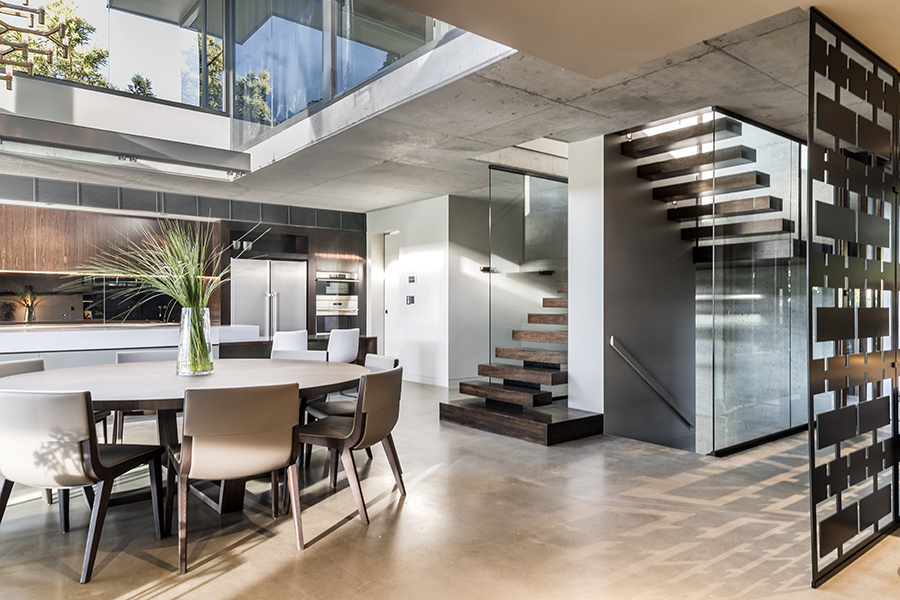
FORTIS Coat 526 is a two-component, water-based clear polyurethane coating for concrete and timber. Available in Gloss and Satin, it provides a durable, UV-stable, abrasion-resistant finish with low odour and ultra-low VOC content. Coat 526 Gloss is self-priming on suitably prepared surfaces, while Satin is used as the final coat over Gloss.
Information | Applications | Specifications | Downloads | FAQs
FORTIS Coat 526 is a high-performance, two-component water-based polyurethane coating designed to protect and enhance concrete and timber surfaces. Its clear, UV-stable formulation provides excellent wear and abrasion resistance while maintaining a natural appearance.
With ultra-low VOC content of less than 10 g/L and low odour, Coat 526 is suitable for residential and commercial flooring, concrete benchtops, walls, stairs and timber floors.
Gloss: Self-priming on suitably prepared concrete and timber. Use Coat 526 Gloss for the initial, build and final coats.
Satin: Designed as the final coat over Coat 526 Gloss. Apply Gloss for the initial and build coats, followed by Satin to achieve the desired lower-sheen finish.
A typical system requires 2–3 coats, depending on the substrate and finish required. Coverage is approximately 12–15 m²/L per coat.
Coat 526 can be applied by brush, roller or spray. The two components are mixed at 4.5 parts A to 1 part B by volume.
Two-component water-based polyurethane
Surfaces must be clean, dry, sound and suitably prepared. Remove contaminants that may affect adhesion. Coat 526 Gloss is self-priming on properly prepared concrete and timber; a separate primer is not normally required.
Stir Part A thoroughly. Mix 4.5 parts A with 1 part B by volume. Slowly add Part B while mixing with a suitable variable-speed mixer. Avoid introducing air and mix for at least 3 minutes. Filter if required.
Apply by brush, roller or spray at 12–15 m²/L per coat. For rolling, pour mixed material in ribbons across the surface and use a 5 mm nap microfibre roller.
Gloss: Use Coat 526 Gloss for the initial, build and final coats.
Satin: Use Coat 526 Gloss for initial and build coats, followed by Coat 526 Satin as the final coat.
Apply 2–3 coats in total. Working time is 45–60 minutes; pot life is 2 hours at 25°C.
Recoat after 6–24 hours at 20°C. Maximum recoat interval is 48 hours. Tack-free time is approximately 2–3 hours, with full cure after 7 days. Apply between 10°C and 35°C. Avoid conditions that may cause condensation on the uncured coating.
Clean equipment with water immediately after use. Hardened material requires mechanical removal.
System requirement: Coat 526 Gloss is self-priming on suitable concrete and timber. Coat 526 Satin must be applied as the final coat over Coat 526 Gloss.
5L
Coat 526 Gloss is self-priming on suitably prepared concrete and timber. A separate primer is not normally required.
Gloss is used for initial, build and final coats. Satin is used only as the final coat over Coat 526 Gloss.
Apply 2–3 coats in total. For a satin finish, use Gloss for the initial/build coats and Satin for the final coat.
Yes. Coat 526 is suitable for properly prepared timber flooring as well as concrete surfaces.
Approximately 12–15 m²/L per coat, depending on the surface and application method.
It is typically tack-free after 2–3 hours and reaches full cure after approximately 7 days.
Mix 4.5 parts A to 1 part B by volume. Working time is 45–60 minutes, with a stated pot life of 2 hours at 25°C.
Yes. It is water-based, low odour and contains less than 10 g/L VOC.
Fortis Coat 526 Technical Data Sheet
Fortis Coat 526 Pt.A - Safety Data Sheet
Fortis Coat 526 Pt.B - Safety Data Sheet
Epoxy vs Polyurethane vs Polyaspartic Floor Coatings